NAEMT TECC Course NYC | Tactical Emergency Casualty Care
.png)
Take the NAEMT Tactical Emergency Casualty Care (TECC) 3rd Edition Provider Course in New York City at the BVAC Rescue Response Training Center in Bayside, Queens. This 16-hour, two-day course provides hands-on, scenario-based tactical medical training for EMTs, AEMTs, paramedics, and other prehospital clinicians who may be called upon to provide lifesaving care during high-threat, complex, and unconventional emergency incidents.
The TECC 3rd Edition prepares prehospital clinicians to respond to and care for patients in civilian tactical environments where ongoing threats, limited resources, difficult access, multiple casualties, or the need for rapid evacuation may require traditional emergency medical procedures to be adapted. Students learn to balance effective patient care with responder safety, operational conditions, casualty movement, and changing threat environments.
The course follows the principles of Direct Threat Care, Indirect Threat Care, and Evacuation Care and incorporates updated evidence-based TECC guidelines, hands-on skill stations, patient simulations, and realistic Active Shooter/Hostile Event (ASHE) scenarios.
What You Will Learn in the NAEMT TECC 3rd Edition Course
-
Direct Threat Care: Learn how medical priorities change when an immediate threat remains present. Training emphasizes responder safety, rapid threat-based decision-making, lifesaving interventions, and moving casualties toward a safer environment.
-
Indirect Threat Care: Provide a more complete casualty assessment and treatment once the immediate threat has been reduced or controlled while remaining prepared for changing operational conditions.
-
Evacuation Care: Learn how casualty care continues during movement and evacuation, including reassessment, treatment priorities, communication, casualty tracking, and preparation for transfer to additional medical resources.
-
Life-Threatening Hemorrhage Control: Practice rapid bleeding-control techniques including tourniquet application, wound packing, pressure techniques, reassessment of hemorrhage-control interventions, and other methods used to manage severe traumatic bleeding.
-
Tourniquet Reassessment and Conversion: The TECC 3rd Edition includes a dedicated tourniquet conversion skill station, reinforcing appropriate reassessment and management of previously applied tourniquets as operational and patient-care conditions change.
-
Rapid Trauma Assessment and Treatment Priorities: Develop a systematic approach to identifying and treating immediately life-threatening traumatic injuries while continually reassessing the casualty as conditions change.
-
Airway and Respiratory Emergencies: Recognize and manage airway compromise, respiratory distress, and traumatic chest injuries using interventions appropriate to the provider's training, scope of practice, and local protocols.
-
Chest Trauma Management: Review the assessment and treatment of penetrating and blunt chest trauma and the recognition of life-threatening respiratory complications.
-
Advanced Thoracic Interventions: The TECC 3rd Edition includes an optional lesson on simple/finger thoracostomy for appropriately trained clinicians operating within their scope of practice and approved medical protocols.
-
Shock and Circulation: Recognize signs of traumatic shock, prioritize lifesaving interventions, reassess the casualty, and support circulation during time-sensitive emergencies.
-
Casualty Movement and Extraction: Practice techniques for moving injured patients from dangerous, confined, or difficult environments while balancing casualty care, responder safety, and operational priorities.
-
Triage in High-Threat Incidents: Apply casualty prioritization and triage principles at the appropriate point in the tactical response. The TECC 3rd Edition places increased emphasis on the real-world timing and application of triage during complex incidents.
-
Multiple-Casualty Incident Management: Develop skills for managing multiple injured patients when personnel, equipment, transportation, and medical resources may be limited.
-
Casualty Tracking and Reunification: The TECC 3rd Edition places greater emphasis on casualty tracking and reunification, helping responders maintain accountability as patients move through treatment and evacuation.
-
Psychological Response to Mass-Casualty Incidents: Learn principles for recognizing and addressing psychological effects on patients, survivors, and responders following violent, traumatic, or mass-casualty incidents.
-
Clinician Mental Health: The 3rd Edition expands attention to the psychological impact of high-threat and mass-casualty incidents on EMS clinicians and other responders, including awareness of responder mental health and post-incident considerations.
-
Active Shooter/Hostile Event Scenarios: Apply TECC concepts through realistic ASHE patient-care scenarios incorporated throughout the course to strengthen clinical judgment, communication, teamwork, and tactical medical decision-making.
-
Hands-On Skills and Patient Simulations: The TECC 3rd Edition uses shorter classroom lessons to provide more time for hands-on skills, practical exercises, patient simulations, and scenario-based application of tactical emergency casualty care principles.
Hands-On TECC 3rd Edition Training in Bayside, Queens
The BVAC Rescue Response Training Center provides the current NAEMT TECC 3rd Edition Provider Course in Bayside, Queens, New York City. Our location is convenient for students traveling from throughout Queens, Manhattan, Brooklyn, the Bronx, Nassau County, and Long Island.
The training center is located just steps from the Bayside LIRR station on the Port Washington Branch, providing convenient public transportation access for students traveling from New York City and Long Island.
BVAC's TECC program emphasizes hands-on tactical medical training, practical skill development, patient simulations, and realistic high-threat emergency scenarios. The 3rd Edition provides more time for hands-on training while incorporating updated evidence-based guidance throughout the course.
Event Information
| Event Date | 08-29-2026 9:00 am |
| Event End Date | 08-30-2026 5:00 pm |
| Cut Off Date | 08-28-2026 |
| Individual Price | $475.00 |
| Location | BVAC Rescue Response Training Center |
Venue Information - BVAC Rescue Response Training Center
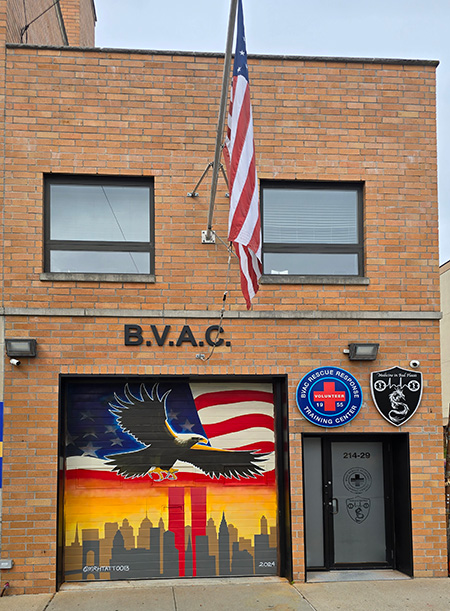
BVAC Rescue Response Training Center
214-29 42nd Ave
Bayside, NY 11361
Please note: We are located on the 2nd floor (no elevator).
Location
-
BVAC is located at 214-29 42nd Avenue, Bayside, New York 11361, in the heart of Bayside, Queens, just steps from the Bayside Long Island Rail Road station on the Port Washington Branch and close to MTA bus service, including the Q13 and Q31 on Bell Boulevard, with additional nearby access to the Q12 and NICE Bus n20G/n20H along Northern Boulevard.
Parking
-
Metered street parking on 42nd Ave
-
$0.25 per 15 minutes
-
2-hour limit
-
Free on Sundays
-
-
Bayside Municipal Parking Field: 41st Avenue & 214th Place, Bayside, NY 11361
-
Free street parking is often available one block past Bell Blvd (east or west)
Important: Do not park in the lot next to our building—vehicles will be towed or may be locked in.
Deposit / Payment Note
Deposit Due Today: $100.00 + Processing Fees
Remaining Balance Due on Class Date: $ 299.00 + Processing Fees
Agendas
Tactical Emergency Casualty Care (TECC) 2-Day Course AgendaDay 1: TECC Foundations, Core Skills & Patient Care
08:00 – 08:30 | Course Welcome & Orientation
08:30 – 09:30 | Module 1: Introduction to Tactical Emergency Casualty Care (TECC)
09:30 – 10:30 | Module 2: Direct Threat Care
10:30 – 10:45 | Break
10:45 – 12:00 | Module 3: Indirect Threat Care
12:00 – 13:00 | Lunch Break
13:00 – 14:30 | Module 4: Indirect Threat Care – Continued
14:30 – 15:30 | Module 5: Evacuation Care
15:30 – 15:45 | Break
15:45 – 17:00 | Hands-On Skills Stations
17:00 – 17:30 | Day 1 Review & Debrief
Day 2: Advanced TECC Skills, Team Operations & Scenario-Based Training
08:00 – 08:30 | Day 1 Review & Day 2 Briefing
08:30 – 09:30 | Module 6: Tactical Casualty Movement & Rescue Operations
09:30 – 10:30 | Module 7: Advanced Hemorrhage Control
10:30 – 10:45 | Break
10:45 – 12:00 | Module 8: Tactical Medical Equipment & Individual Medical Kits
12:00 – 13:00 | Lunch Break
13:00 – 14:30 | Module 9: Scenario-Based TECC Training
14:30 – 15:30 | Module 10: Mass Casualty Incidents & Multiple-Patient Operations
15:30 – 15:45 | Break
15:45 – 16:30 | Final Practical Exercise: Full-Scale TECC Scenario
16:30 – 17:00 | Course Review & Final Q&A
17:00 – 17:30 | Course Completion
Please Note: This is a tentative two-day course agenda and is provided as a general overview of the training program. The schedule, sequence of instruction, skills stations, scenarios, and individual topics may be adjusted based on instructor requirements, class progress, student needs, provider scope of practice, and current TECC course requirements. |