Saving Lives Together — One Skill at a Time. Contact Us.

Call Our Office
EMS Low Light / No Light Operations Course
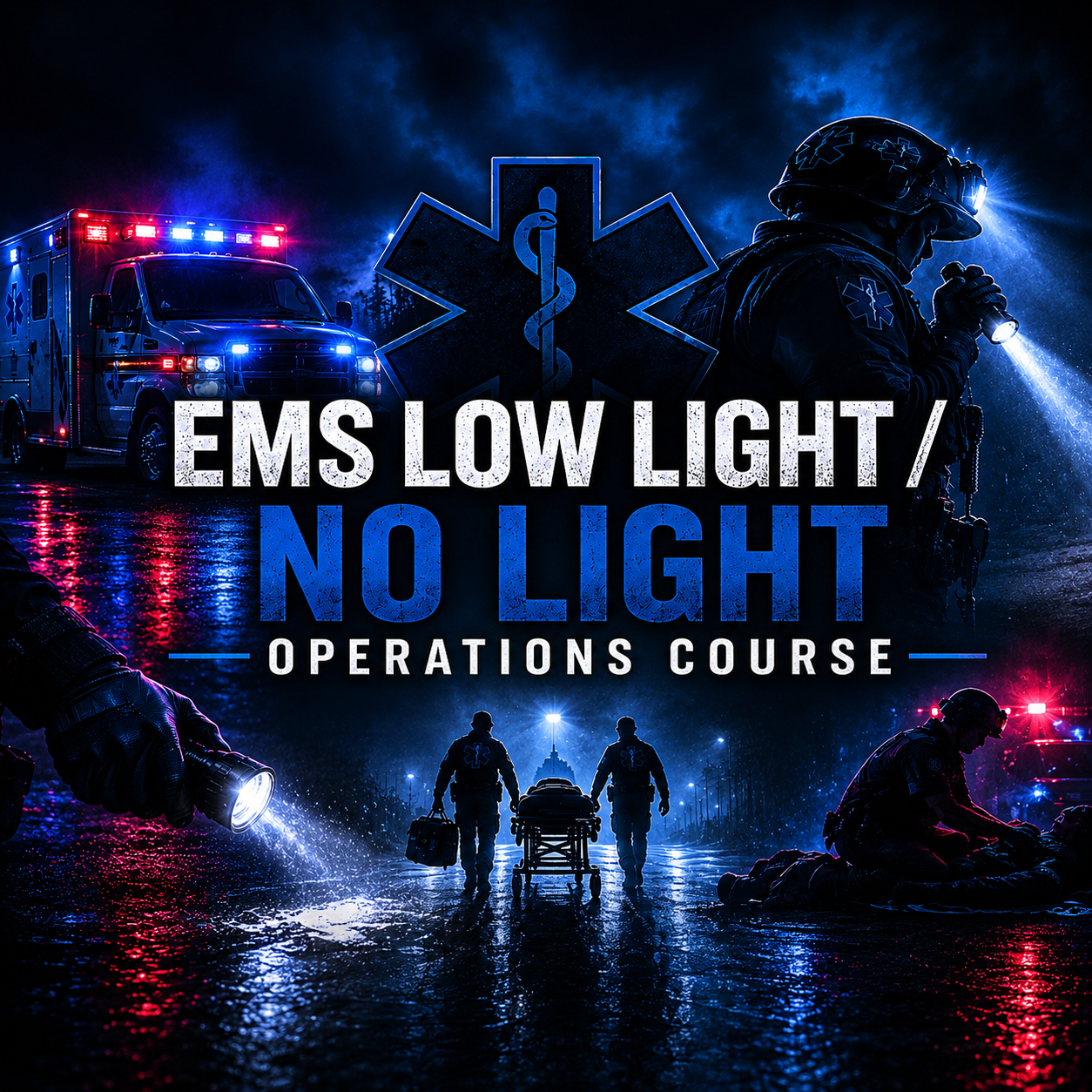
The EMS Low Light / No Light Operations Course is an intensive two-day training program designed to prepare EMS providers, rescue personnel, and first responders to safely and effectively operate in reduced visibility, nighttime, and completely dark environments.
This course focuses on patient assessment, movement, treatment, communication, and scene management under realistic low-light operational conditions commonly encountered during:
- Disasters
• Maritime operations
• Tactical incidents
• Mass casualty events
• Austere environments
• Nighttime emergency responses
Participants will gain hands-on experience using lighting systems, night operations equipment, casualty management techniques, and team-based movement strategies while operating under physical and environmental stressors.
Course Objectives
Upon completion of this course, participants will be able to:
- • Conduct patient assessments in low-light and no-light environments
• Utilize handheld, head-mounted, and scene lighting systems effectively
• Perform medical interventions under degraded visual conditions
• Improve situational awareness and communication during nighttime operations
• Conduct casualty movement and evacuation in confined or hazardous environments
• Operate safely around maritime, industrial, and austere operational hazards
• Integrate team movement and scene coordination techniques
• Apply light discipline principles during tactical and rescue operations
Target Audience
This course is designed for:
- • EMTs
• Paramedics
• Fire Rescue Personnel
• Tactical Medics
• Maritime Rescue Teams
• Search & Rescue Personnel
• Industrial Emergency Response Teams
• Law Enforcement Medical Support Personnel
Course Duration
- • Two (2) Days
• Approximately 16 training hours
Equipment Requirements
Students should bring:
- • Duty uniform or appropriate field attire
• Flashlight and/or headlamp
• PPE appropriate to the operational environment
• Note-taking materials
Additional training equipment may be provided by the hosting agency.
Course cost includes:
- • Instruction
• Training materials
• Practical exercises
• Scenario-based training
• Certificate of completion
Certification
Students who successfully complete the course will receive a Certificate of Completion for EMS Low Light / No Light Operations.
Event Information
| Event Date | 09-01-2026 9:00 am - 5:00 pm |
| Cut Off Date | 09-01-2026 |
| Individual Price | Contact Us to Inquire About Classes |
Agendas
EMS Low Light / No Light Operations Course Agenda
Day One: Low-Light Operations, Patient Care & Practical Skills
Morning Session: Foundations of Low-Light Operations
Midday Session: Medical Operations in Reduced Visibility
Afternoon Session: Hands-On Practical Exercises
Day Two: Advanced Operations & Scenario-Based Training
Morning Session: Advanced Low-Light Response
Midday Session: Multi-Patient & Casualty Evacuation Operations
Afternoon Session: Final Practical Scenarios & Evaluation
Important Course InformationThis tentative agenda is intended to provide a general overview of the two-day Low-Light / No-Light Operations course. The program combines classroom instruction, hands-on skills development, team-based exercises, and realistic scenario training designed to challenge participants in reduced-visibility environments.
Actual course timing, instructional sequence, training scenarios, and practical evolutions may be modified based on instructor discretion, student performance, weather, environmental conditions, available training space, equipment availability, and operational safety requirements. |
We are no longer accepting registration for this event
